
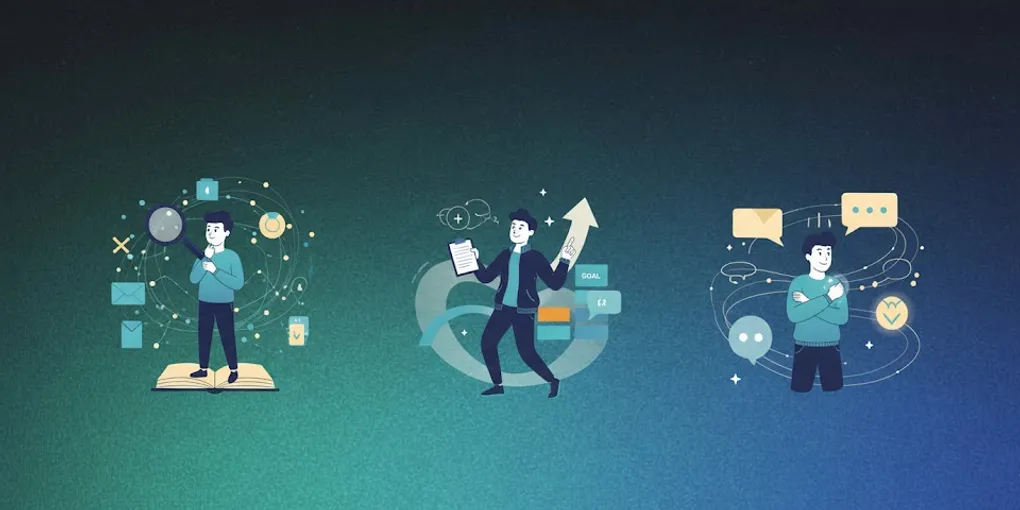
As an engineering manager in AI, I constantly have to choose between LLMs. Benchmarks tell us which models excel at ‘hard’ tasks (the ones with right or wrong answers). However, management work resides in the messy middle: diagnosing team dynamics, delivering difficult feedback, and coaching through ambiguity. No benchmark measures that. So I built my own heuristic—one that helped me understand not just the models, but my own thinking patterns.
Three Model Heuristic
I’m fortunate to have access to three models: ChatGPT, Gemini, and Claude. I’ve used all of them extensively. Each has its own strengths and quirks. After conducting dozens of experiments (and a few failures), I began to notice patterns. Here’s the heuristic I now use to decide which “personality” to call on for which kind of work.
ChatGPT: The Researcher
Whenever I think of ChatGPT, I try to imagine a dedicated researcher. It loves details and connecting concepts across disciplines. It helped me reflect on my own thinking, debug my reasoning, and push me to think more clearly. I treat it like an academic sparring partner: curious, meticulous, sometimes pedantic.
When I need to understand something, I call on ChatGPT. It is strong at building frameworks, mapping a domain, or testing ideas. It usually thinks in outlines, categories, and structure. I love to throw a messy dump of notes at it and ask for structure and a coherent hypothesis. I also use it to find variations of similar or contrasting ideas, or to poke holes in half-baked ideas.
-
When to use:
Framework discovery, idea comparison, analysis, self-reflection, and structured questioning. -
Watch-outs:
It can drown you in information, details, and text. It invites ever deeper and further exploration. Ask for concise answers to keep it crisp. Don’t use alone for comms that need emotional nuance; pair with Claude to soften.
Gemini: The Strategic Coach
Gemini is a Ted-Lasso-like strategic coach and project manager. It focuses on outcomes, structure, and sustainable progress. It can use tough love to drive me to action, but it is also able to understand messy life and show empathy.
I like to feed it with vague goals or inhibiting patterns so that it can come up with step-by-step plans, set accountability, and create momentum. Due to its massive context window, I use it for long-running coaching conversations.
-
When to use:
Decision-making, planning, goal-setting, and iterative improvements. Also useful as a contrasting perspective when ChatGPT’s analysis feels too neat. -
Watch-outs:
It errs on the side of action. Don’t jump in here if the problem is fuzzy, as it risks executing the wrong plan.
Claude: The Creative Empath
Claude excels in communication. Its ability to take heavy, complex, or emotionally charged ideas and translate them into something human and digestible is superb. Where ChatGPT dissects and Gemini motivates, Claude feels. It has a strong sense of tone and nuance.
When I’m writing sensitive messages, reflecting on difficult feedback, or polishing narratives for clarity and emotional resonance, Claude is a great and empathetic partner. Another strong suit of Claude is creative writing; therefore, I use it for coaching my writing, finding metaphors, shaping voice, and making walls of text digestible.
-
When to use:
Writing, messaging, storytelling, or emotional calibration. -
Watch-out:
It sounds confident, even when it’s just guessing. Always double-check facts. Don’t rely on it to establish facts; pair with ChatGPT for verification.
Quick Reference
- Researcher (ChatGPT):
“Find me the map, test my assumptions, reveal the blind spots.” - Strategic Coach (Gemini):
“Given the map, what’s the route and what do we do first?” - Creative Empath (Claude):
“Say it so people can hear it, and so I can hear myself.”
Example
Say I need to diagnose why our sprint retros keep falling flat.
-
Researcher: Frame and Interrogation
I collect all my notes and brain dump them into ChatGPT. To broaden my perspective, I ask for thought-provoking questions, which I then answer. From there, I extract patterns and explore frameworks for problem-solving. Finally, I distil this into a report with a recommended solution, including trade-offs and reasoning. -
Strategic Coach: Plan and Commit
At this point, I feel confident to execute. So, I encourage Gemini to come up with an actionable plan and push me to take the first steps. This includes a general long-term plan with checkpoints, as well as short-term “next steps”, including premeditation of failure and how to handle it. -
Creative Empath: Process and Reframe
In the end, if I have to have crucial conversations, I turn to Claude as a creative empath, to improve my writing, highlight blind spots and different viewpoints. Usually, I am so stuck in my own POV or thinking that Claude can improve my sensitivity and anticipate misconceptions. During the general process, there often come moments when I feel raw and realise that we are touching on personal weaknesses. Sometimes, it helps me to become more open to harsh truths, if Claude tries to make it warm and nice.
Seeing the models through these lenses helps me to recognise my own cognitive patterns. When am I overanalysing? I should reach for the Coach! When am I rushing to solutions? Let me root myself again by consulting the Researcher. When feeling detached, I invite the Empath.
However, these heuristics are less a rule and more like a gentle indication of where my current thinking tends to lean. It’s about noticing my inner voice and reflecting on which role I am taking right now. And which ones I’ve forgotten to listen to.